Dynamic Markets: the next generation of flexible, compliant procurement
In England, Wales, and Northern Ireland, the Procurement Act 2023 has replaced Dynamic Purchasing Systems with a more powerful procurement tool. Dynamic Markets keep the features that made DPS useful, including open supplier entry, electronic management, and continuous competition, and extend them further. They can be used for any type of goods, works, or services, not just commonly available purchases, giving public sector organisations faster, broader, and more transparent access to the suppliers they need.
A Dynamic Market is a procurement tool introduced by the Procurement Act 2023, available to contracting authorities in England, Wales, and Northern Ireland. Scotland retains its own separate procurement legislation, which does not include an equivalent tool, although eligible devolved Scottish authorities can use a Dynamic Market established under the Act through the UK's cross-border procurement arrangements.
A Dynamic Market creates a list of qualified suppliers who have met published conditions for membership and are eligible to participate in future procurements. Unlike a traditional framework, where the supplier list is fixed for the life of the agreement, a Dynamic Market stays permanently open. New suppliers can apply to join at any time, and contracting authorities must consider their applications within a reasonable period.
When you need to procure through a Dynamic Market, you publish a tender notice and run a competition using the competitive flexible procedure. You can invite all members of the relevant part of the market, or select a subset based on objective, pre-published criteria, whichever suits the requirement. Suppliers who are not yet members can also apply to join and participate in the same procurement, provided the contracting authority has time to consider their application before the competition closes. This keeps the process both competitive and accessible, without requiring every competition to go to the entire membership list. Inprova can manage this process for you, from designing the competition through to award.
Our procurement specialists can help you plan a compliant route to market, review your current project or identify the right solution for your organisation.
Sorry, we couldn’t find any team members that match your current filters.
Moving from DPS to Dynamic Markets: what it means for you
In England, Wales, and Northern Ireland, the Procurement Act 2023 has introduced Dynamic Markets as the successor to the traditional Dynamic Purchasing System model. If you are currently using a DPS, or considering one for the first time, here is what the change means in practice for those nations.
If you are currently procuring through one of our Dynamic Purchasing Systems, nothing changes overnight. Under the Procurement Act 2023’s transitional provisions, existing DPS solutions remain legally valid and fully operational. They will continue to run until they expire, or until 23 February 2029, whichever comes first. This transitional deadline applies to DPS agreements established under PCR 2015 and does not affect Scotland’s own procurement arrangements, which sit under entirely separate legislation.
What you will notice:
Broader scope: Dynamic Markets can cover any type of goods, works, or services. Under the previous legislation, whether a particular requirement, including specialist construction, retrofit, or consultancy, could be run through a DPS depended on the detail of that requirement rather than a blanket exclusion of the category. Dynamic Markets remove that restriction altogether.
Simplified supplier entry: the qualification process is streamlined, meaning new suppliers can join more quickly and with less administrative friction
Competitive flexible procedure: all contracts awarded under a Dynamic Market use this procedure, which gives you more flexibility in how you structure and evaluate competitions
Greater transparency: the Procurement Act requires publication of a Dynamic Market notice when the market is established, modified, or terminated, alongside tender notices, contract award notices, and contract details notices for each procurement
What stays the same:
The supplier base remains open throughout the lifetime of the agreement
Our team provides the same hands-on support, from identifying the right route through to managing the contract after award
Quantum continues to provide spend visibility, pricing validation, and performance tracking for every contract
All routes are fully compliant, documented, and designed to withstand audit and scrutiny
If you have questions about how the transition affects a specific procurement need, our team is happy to talk it through.
How Dynamic Markets differ from Dynamic Purchasing Systems
Dynamic Markets build on the principles of the Dynamic Purchasing System but address the limitations that held DPS back under previous legislation. Here are the key differences:
Broader scope: DPS was restricted to purchases that were commonly available on the market. Dynamic Markets remove that restriction, so any type of goods, works, or services can be procured through one, with eligibility for a particular requirement depending on its specifics rather than a blanket exclusion by category
Simplified qualification: the process for admitting new suppliers is streamlined, reducing delays and making it easier for SMEs and specialist contractors to participate
Greater flexibility: contracting authorities have more freedom in how they structure lots, set membership conditions, and organise the market to reflect their procurement needs
Clearer legal framework: the Procurement Act removes many of the ambiguities that surrounded DPS operation, providing greater certainty for both buyers and suppliers
Supplier removal: a contracting authority can remove a supplier from a Dynamic Market where the supplier meets one of the Act’s mandatory or discretionary exclusion grounds and the required removal procedure has been followed. Poor performance or a breach of contract does not automatically justify removal; the statutory grounds and process must be satisfied first, something that was procedurally much harder to achieve under the DPS model.
How Dynamic Markets fit alongside frameworks
Dynamic Markets and frameworks serve different purposes and many organisations will use both. Frameworks provide a fixed list of pre-approved suppliers for a set term, which works well for stable, recurring requirements with established pricing. Dynamic Markets are better suited to categories where the supplier landscape is evolving, where you want continuous competition, or where access to specialist or local suppliers matters.
Between the three tools, procurement frameworks, Dynamic Purchasing Systems, and Dynamic Markets, you have a range of compliant procurement routes that can be matched to the specific characteristics of what you are buying.
Procurement has the power to do more than manage spend.
Done well, it strengthens organisations, improves outcomes, and creates lasting value. That’s why we’re Inprova, a technology-enabled procurement partner helping public sector organisations turn procurement into a measurable force for good. We combine compliant procurement routes, specialist consultancy, and the Quantum platform into a joined-up service that supports your organisation from procurement through to contract delivery.
Unlike traditional procurement providers, we don’t step away once a contract is awarded. We stay with you to help ensure the value you set out to achieve becomes a reality
Become a supplier
Our Dynamic Purchasing Systems (DPS) remain open throughout their term, so suppliers can apply to join whenever they are ready. Once approved, suppliers can compete for opportunities through mini-competitions.
We run our tenders through Panacea, our e-tendering system, and our supplier guide explains the process in more detail.
When you sign in to Panacea, you’ll see the Procurement for Housing (PfH) logo. PfH is the contracting authority for our solutions, so Inprova and PfH opportunities share the same Panacea link.
Register and search: create your Panacea account and look through our live opportunities.
Apply: answer the tender questions, select the lots relevant to your business and attach your supporting documents.
Hear back: we’ll evaluate your application and share the outcome in Panacea. If you’re successful, we’ll guide you through onboarding.
When you can apply depends on the route. DPS and Dynamic Markets accept applications at any point during their term, while frameworks only accept them during their tender window, so it’s worth keeping an eye out for new opportunities.
Any contracting authority can establish a Dynamic Market. What matters is the quality of the supplier base, the rigour of the qualification process, and the support that comes with it. Here is what you get with ours.
A supplier base that grows with the market
Our Dynamic Markets include national contractors, regional specialists, SMEs, and VCSE organisations. Because the market stays permanently open, new suppliers with emerging capability can join as soon as they meet the conditions for membership. That means the options available to you today will be broader than they were six months ago, and broader still in another six months. The result is genuine choice across every procurement.
Rigorous, proportionate qualification
Every supplier admitted to an Inprova Dynamic Market has been assessed against published conditions for membership covering financial stability, technical capability, relevant experience, health and safety, and insurance. The conditions are proportionate to the contracts being awarded, with specific consideration for SMEs. The process is transparent, documented, and designed to give you confidence that every supplier on the market has earned their place.
Support from our team throughout the contract lifecycle
Our team helps you identify the right Dynamic Market, structure your competition, and manage the process through to contract award. After award, our team continues to support you through the lifetime of every contract, helping you manage supplier relationships, resolve issues, and make sure you are getting the value that was agreed. Quantum, our spend and contract management platform, sits alongside that support, giving you visibility of spend, pricing, performance, and compliance in a single secure view.
Compliance built in from day one
Our Dynamic Markets are established in full compliance with the Procurement Act 2023. The competitive flexible procedure is used for all contract awards. Supplier qualification, tender notices, contract award notices, and contract details notices are all managed in line with the Act’s transparency requirements. Audit trails are built in, so every decision is evidenced and defensible.
Quantum: take control of your contracts with the right data at your fingertips
Extract more value from your contracts
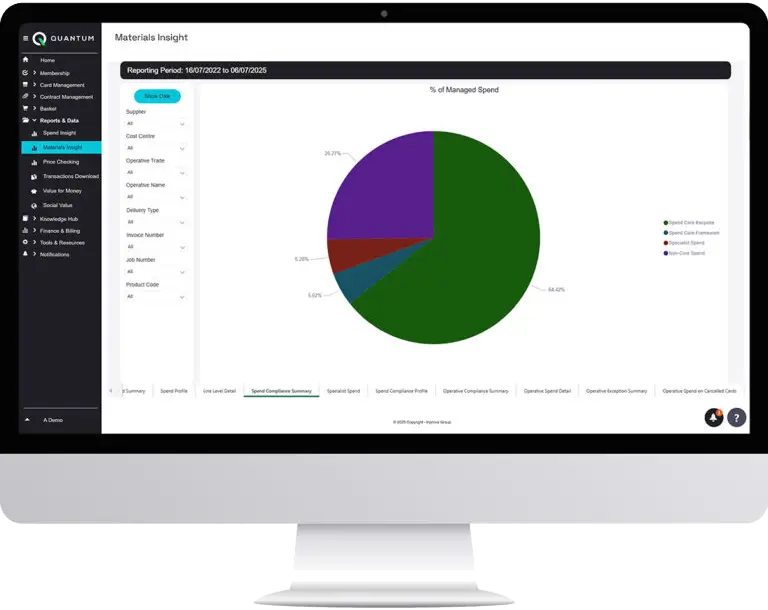
Quantum is our spend and contract management platform built for public sector organisations managing multiple suppliers, contracts and compliance obligations at once. For the agreements you run through Inprova, it brings together your contract register, transaction-level spend data, pricing validation, consolidated billing and performance tracking into a single secure platform that procurement, finance and operations teams all draw from. Spend data and pricing validation cover your product-based contracts.
What that means in practice:
Every Inprova contract, document and obligation in one searchable location, with automatic expiry and renewal alerts
Your spend through our product-based contracts aggregated into a single consistent view, with line-level detail on every transaction
A single consolidated monthly statement per supplier, replacing large volumes of individual invoices
Structured tracking of contract obligations, including social value, with an auditable evidence record
Our Dynamic Markets are available to contracting authorities in England, Wales, and Northern Ireland, and to eligible devolved Scottish authorities through the UK’s cross-border procurement arrangements. The flexibility they offer is particularly valuable in sectors where requirements change quickly, where funded programmes need to mobilise at pace, or where access to specialist and local suppliers makes a measurable difference to outcomes.
Education
Schools, multi-academy trusts, and universities managing estate improvements, compliance works, and time-limited capital programmes benefit from the open supplier model and faster mobilisation that Dynamic Markets provide.
Healthcare
NHS trusts and Integrated Care Boards (ICB’s) benefit from a continuously refreshed supplier base for estates maintenance, compliance, and retrofit works. Dynamic Markets provide the flexibility to respond to changing requirements across complex, multi-site estates.
Local government
Councils managing broad procurement portfolios can use Dynamic Markets to reduce the burden of individual tenders while maintaining full compliance with the Procurement Act’s transparency obligations. The open model also supports local economic participation.
Blue light
Police, fire and rescue, and ambulance services can access pre-qualified contractors for estates, compliance, and operational requirements through Dynamic Markets without the lead time of a full procurement exercise.
Do you need tailored procurement support?
Frequently asked questions
In England, Wales, and Northern Ireland, all contracts awarded through a Dynamic Market must use the competitive flexible procedure, which is one of the new procurement procedures introduced by the Procurement Act 2023. Although Scotland retains its own procurement legislation, eligible Scottish authorities can use dynamic markets established under the Act through the cross-border arrangements. This is a significant difference from the DPS model, where contracting authorities used the restricted procedure or ran mini-competitions under more rigid rules. The competitive flexible procedure gives you considerably more freedom in how you structure and run each competition.
In practice, this means you can design a multi-stage process that suits the complexity of what you are buying. For a straightforward compliance contract, you might run a single-stage competition evaluated on quality and price. For a complex construction programme in an occupied NHS hospital or a multi-site decarbonisation retrofit across a trust’s school estate, you might include a selection stage to shortlist suppliers, followed by further evaluation, dialogue, or negotiation before final tenders are submitted. The procedure allows you to adapt the process to the requirement rather than forcing every procurement through the same rigid structure.
You set the evaluation criteria, the weightings, the number of stages, and the timeline for each competition. Inprova’s team supports you through the design and management of each process, ensuring it is compliant with the Procurement Act’s requirements around transparency, equal treatment, and proportionality while giving you the flexibility to get the best outcome for your specific project. This combination of an open supplier base and a flexible competition procedure is what makes Dynamic Markets the most versatile procurement route available under the new legislation.
In England, Wales, and Northern Ireland, the Procurement Act 2023 addressed several limitations that held the DPS model back. Understanding these differences matters if you are deciding whether to continue using an existing DPS or move to a Dynamic Market for new procurement activity.
Scope is the most significant change. Under previous legislation, a DPS could only be used for purchases that were commonly available on the market, and whether a particular specialist construction, retrofit, or consultancy requirement qualified depended on the detail of that requirement rather than an automatic exclusion of the category. Dynamic Markets remove that restriction. Any type of goods, works, or services can be procured through one, giving contracting authorities a more straightforward route for bespoke and complex requirements without testing each one against the old commonly available purchase requirement.
Supplier management is also clearer. A contracting authority can remove a supplier from a Dynamic Market where that supplier meets one of the Act’s mandatory or discretionary exclusion grounds, which can include poor performance or breach of contract, but only once the relevant statutory grounds and removal procedure have been satisfied. Poor performance or a breach on its own is not sufficient. Under the DPS model, removing an underperforming supplier was procedurally difficult even where the grounds seemed clear. Dynamic Markets also allow contracting authorities to charge suppliers a fee when they are awarded a contract, enabling central purchasing bodies to sustain and develop their commercial tools. The qualification process is simplified, reducing delays for new suppliers joining, and the competitive flexible procedure replaces the more rigid procedures that applied to DPS competitions, giving buyers more control over how each procurement is structured and evaluated. For public sector organisations that found the DPS model useful but frustrating in its limitations, Dynamic Markets deliver the same core benefits with fewer constraints.
NHS trusts in England operate under two distinct procurement regimes simultaneously. The Provider Selection Regime, in force since January 2024, governs how NHS organisations arrange healthcare services for patients. The Procurement Act 2023 applies to everything else, including estates maintenance, construction, facilities management, compliance services, IT, and corporate services. Dynamic Markets fall under the Procurement Act and provide a compliant route for the non-clinical procurement categories where estates and facilities teams need reliable supplier access. This route is specific to England, Wales, and Northern Ireland. NHS Scotland’s non-clinical procurement sits under Scotland’s own separate legislation, though under the cross-border arrangements now in force, an eligible devolved Scottish health board could use a Dynamic Market established under the Act where a UK-wide or cross-border requirement makes that the right route.
For NHS procurement teams, the practical advantage of a Dynamic Market is that it provides a pre-established compliant procurement vehicle for the Procurement Act categories without requiring the trust to build its own compliant processes from scratch. The competitive flexible procedure gives flexibility to tailor each competition to the specific constraints of healthcare procurement, including requirements around working in occupied clinical environments, infection control protocols, and out-of-hours delivery. Because Dynamic Markets stay permanently open, NHS trusts are not limited to the contractors who were available when the market was established. Specialist compliance contractors, decarbonisation installers, and construction firms with healthcare experience can join as they meet the membership conditions.
With NHS England’s net zero targets of 2040 for direct emissions and 2045 for the supply chain, and Carbon Reduction Plan requirements expanding to all suppliers by April 2027, the breadth of non-clinical procurement that NHS trusts need to manage compliantly is growing. Dynamic Markets provide the flexible, evolving procurement infrastructure that this demands.
In England, Wales, and Northern Ireland, the Procurement Act 2023 introduced both Dynamic Markets and open frameworks as new procurement tools. They share some characteristics but serve different purposes, and understanding the distinction helps you choose the right route for each requirement.
Open frameworks allow new suppliers to join at defined intervals during the framework’s lifetime, typically through periodic re-opening windows. Between those windows, the supplier list is fixed. Pricing and terms are typically established at the point of appointment. Open frameworks are well suited to categories where a degree of supplier stability is valuable but you want the option to refresh the supply chain periodically rather than waiting for a full retender.
Dynamic Markets stay permanently open. There are no fixed re-opening windows. Any supplier that meets the published conditions for membership can apply and join at any time. You set your own pricing structure and evaluation criteria for each individual competition rather than working from pre-agreed terms. This makes Dynamic Markets better suited to categories where the supply chain is evolving continuously, where you need maximum flexibility in how you structure each procurement, or where access to the broadest possible supplier base for every competition matters.
In practice, many organisations will use both. An open framework might serve well for stable, high-volume categories like materials supply. A Dynamic Market might be the better choice for construction, decarbonisation, or specialist compliance services where the market is moving quickly and the specification varies significantly between projects. Inprova’s team can advise on which route fits each requirement.
A supplier can be removed from a Dynamic Market, but this is not automatic. Poor performance or a breach of contract on their own do not justify removal. The contracting authority has to establish that the supplier meets one of the Act’s mandatory or discretionary exclusion grounds and follow the required removal procedure before the supplier can be excluded.
Mandatory grounds include serious offences such as fraud, bribery, money laundering, and tax evasion, where exclusion is not discretionary. Discretionary grounds cover a broader range of issues, including poor performance on a previous public contract, breach of contract, and significant or persistent deficiencies in meeting substantive contractual obligations, but the contracting authority still has to assess the evidence against those grounds and follow the required process before removing a supplier from the market.
For public sector organisations managing critical services, this matters. An NHS trust relying on a compliance contractor for statutory fire safety testing, a school dependent on a heating contractor for term-time emergency response, or a council managing a major capital works programme cannot afford to be locked into a supply chain that includes contractors who have demonstrably failed to deliver. The ability to remove underperforming suppliers, once the statutory grounds are met, and replace them with new entrants who meet the membership conditions keeps the Dynamic Market supply chain actively managed rather than passively maintained. Inprova monitors supplier performance across all our procurement routes and can advise contracting authorities on the statutory grounds and evidence required where removal is being considered.
The Education Estates Strategy, published in February 2026, commits £38 billion from 2025-26 to 2029-30 to transform the education estate across England. This includes nearly £20 billion for the School Rebuilding Programme, £710 million for renewal and retrofit, £3.7 billion for SEND capital, and almost £3 billion per year for long-term maintenance by 2034-35. Scotland, Wales, and Northern Ireland each run their own school capital investment programmes. For English schools, multi-academy trusts, and colleges accessing Education Estates Strategy funding specifically, the procurement challenge is spending it efficiently, compliantly, and at the pace that delivery timescales demand, and Dynamic Markets are available as a route in England, Wales, and Northern Ireland to help meet that challenge.
Dynamic Markets are particularly well suited to this because they combine three things education institutions need: speed, flexibility, and compliance. The competitive flexible procedure allows you to design each competition around the specific requirements of each funded project rather than working within a fixed framework structure. The permanently open supplier base means you are not limited to contractors who were available when the procurement route launched, which matters when delivery timescales are tight and regional contractor availability varies. And because the Dynamic Market is an established compliant procurement vehicle under the Procurement Act 2023, the compliance documentation, audit trails, and transparency requirements are built in from the start.
With new estate management reporting requirements arriving from autumn 2026, education institutions also need procurement routes that generate structured, auditable data. Quantum tracks every contract awarded through our Dynamic Markets, providing the spend visibility, contract management, and performance evidence that the new reporting standards will require.
Local authorities manage the broadest range of building types and procurement categories in the public sector. Offices, leisure centres, libraries, schools, depots, care homes, and civic buildings each have different maintenance requirements, compliance profiles, and capital investment needs. In England, Wales, and Northern Ireland, the Procurement Act 2023’s expanded transparency and reporting obligations add administrative burden to procurement teams that are already managing this breadth with constrained resource. The LGA estimates a cumulative funding gap of £6.2 billion across 2025/26 and 2026/27 in England alone, just to sustain services at current levels.
Dynamic Markets address this by providing a single compliant procurement route that works across the full range of categories a council procures. Because you set your own specification and evaluation criteria for each competition, the same Dynamic Market can serve a leisure centre heating replacement, a library accessibility improvement, and a depot roofing project without requiring three separate procurement routes. The permanently open supplier base means the contractors available for a competition in one region are not limited to those who were on the system when the market launched. Local SMEs and regional specialists can join at any time, supporting local economic participation.
For councils going through Local Government Reorganisation, Dynamic Markets provide continuity that standalone procurements do not. Any successor authority created through reorganisation can continue using the Dynamic Market without re-procurement, maintaining supplier access and programme continuity during a period of significant organisational change.
A Dynamic Market carries its own set of transparency requirements, separate from the notices around DPS expiry. A Dynamic Market notice is published when the market is established, and again if it is modified, for example if a new part is added, or when it is terminated. This means anyone can see which markets exist, what they cover, and the conditions for joining.
For each procurement run through the market, the contracting authority publishes a tender notice, confirming that the contract will be awarded by reference to membership of the market, or the relevant part of it. Before entering into the contract, the contracting authority must also publish a contract award notice. Unlike many framework call-offs, contract award notices for Dynamic Market awards must be accompanied by assessment summaries, giving suppliers who took part in the competition information about how their tender was assessed.
One difference from most above-threshold procurements is standstill. There is no mandatory eight-working-day standstill period for contracts awarded under a Dynamic Market. A contracting authority can choose to apply a voluntary standstill of at least eight working days if it wants to give suppliers a window to raise concerns before the contract is signed, but it is not required to. After the contract is entered into, a contract details notice is published confirming the award.
Inprova manages this notice cycle for every competition we run through our Dynamic Markets, so the audit trail is complete without your team needing to track each requirement separately.
In England, Wales and Northern Ireland, under the Procurement Act 2023’s transitional provisions, all Dynamic Purchasing Systems established before 24 February 2025 remain legally valid and fully operational. They will continue to run until they reach their natural expiry date, or until 23 February 2029, whichever comes first. After that date, no DPS established under the previous legislation can continue to operate. Any procurement route of this type must be established as a Dynamic Market under the new Act.
For public sector organisations currently using Inprova’s DPS solutions, this means you can continue procuring through them with confidence for now, and there is no immediate action required on your part. A DPS does not convert into a Dynamic Market automatically. When a DPS reaches its expiry date, or 23 February 2029, whichever comes first, a genuine replacement Dynamic Market has to be established under the Procurement Act 2023 rules. Our team manages that process on your behalf, including the new market notice, membership conditions, and qualification process, so you are not left without a compliant route. The procedure itself does change: procurements run through the new Dynamic Market use the competitive flexible procedure and the Act’s notice requirements rather than the process that applied under the DPS. What stays consistent is the level of support from our team and the visibility Quantum gives you over spend and performance.
Where the transition matters is in planning. If you are designing a multi-year capital programme or procurement strategy that extends beyond 2029, you should factor Dynamic Markets into that planning rather than assuming existing DPS solutions will still be available. Inprova’s team can advise on the transition timeline for each of our procurement routes and help you understand what, if anything, changes for your organisation. For new procurement activity, our Dynamic Markets are already operational under the Procurement Act 2023, so there is no reason to wait for the transition if a Dynamic Market route covers your requirement today.
Yes, and this is one of the features that makes Dynamic Markets practical for covering a broad range of procurement needs within a single compliant vehicle. A Dynamic Market can be divided into categories or parts, allowing you to organise suppliers by specialism, geography, value range, type of work, or any other logical grouping that reflects how you actually procure.
When you run a competition, you specify which part or parts of the Dynamic Market it relates to, and only suppliers who are members of those parts are eligible to participate. This means a Dynamic Market covering building works might have separate parts for general maintenance, electrical works, roofing, and painting, each with its own membership conditions and supplier base. A competition for electrical works would only go to suppliers admitted to that part, not to the entire market.
For public sector organisations managing diverse procurement portfolios, this structure provides the breadth of a single compliant procurement vehicle with the specificity of targeted supplier pools for each category. An NHS trust could access compliance specialists, construction contractors, and decarbonisation installers through different parts of the same Dynamic Market. A multi-academy trust could procure heating works from one part and fire safety services from another without needing separate procurement routes. The conditions for membership in each part must be proportionate to the contracts being awarded through it, with the Procurement Act requiring specific consideration for SME accessibility when setting those conditions.
In England, Wales, and Northern Ireland, the Procurement Act 2023 places a stronger emphasis on SME access to public sector procurement than any previous legislation. The National Procurement Policy Statement sets an explicit expectation around SME participation for UK central government departments, and the government’s ambition is to award a third of central government contract spend to SMEs. Dynamic Markets are designed with these objectives built into their structure.
Because a Dynamic Market stays permanently open, SMEs and specialist contractors are not excluded by fixed tender deadlines that closed months or years ago. A business that was not established, did not have the track record, or did not have the capacity when a framework was originally tendered can apply to join a Dynamic Market as soon as it is ready. The Act also requires that conditions for membership are proportionate and do not disadvantage smaller organisations. Turnover requirements, insurance thresholds, and experience criteria must be set at a level that reflects the contracts being awarded, not inflated to a level that filters out capable SMEs.
In 2025, £193.5m of spend through Inprova went to SME suppliers, a record year, up 51% on 2024. Our Dynamic Markets continue this commitment by ensuring membership conditions are proportionate, regional parts give local businesses a meaningful route to compete, and the competitive flexible procedure allows you to weight quality and social value alongside price rather than defaulting to lowest cost. For public sector organisations with explicit SME spending targets, whether through the NPPS or their own procurement strategies, Dynamic Markets provide the structural mechanism to deliver on those commitments.
This is one of the practical questions that distinguishes Dynamic Markets from frameworks. I if a supplier who is not yet a member of the Dynamic Market wants to participate in a live competition, they can submit an application to join at the same time. The contracting authority must consider that application, provided there is sufficient time to do so before the competition closes.
In practice, this means a supplier could see a tender notice published for a competition through a Dynamic Market, apply for membership, be assessed against the published conditions, be admitted, and participate in the same competition. The contracting authority is not obligated to delay the competition to accommodate late applications, but must consider them if the timeline allows. This provision reflects the Procurement Act’s emphasis on keeping public procurement as open and accessible as possible, even during live competitions.
For buyers, this is a net positive. It means your competitions can attract suppliers you might not have known about, increasing the competitiveness of responses. For suppliers, particularly SMEs and specialist firms who may not have been monitoring the Dynamic Market for membership opportunities, it removes a barrier that would otherwise lock them out of a specific opportunity. Inprova’s team manages the membership assessment process alongside the competition timetable, so this provision works smoothly in practice without creating administrative complexity for your procurement team.
Yes, provided the charity meets the Act’s definition of a contracting authority. Under the Procurement Act 2023, an organisation qualifies if it is either wholly or mainly funded from public funds, or subject to the management or control of one or more public authorities, and it does not operate on a commercial basis. Holding contracts with public sector bodies, or delivering publicly funded services, does not by itself make a charity a contracting authority. What matters is the source and proportion of its funding, or the degree of oversight a public authority has over it, alongside whether it operates commercially, for example by bearing its own losses and competing in a market subject to fair competition.
Many charities and VCSE organisations do meet this definition, particularly those that receive the majority of their funding from public sources or that are established, and overseen, by a public authority to carry out functions in the public interest. Every charity’s position is different, and the assessment has to be made against its own funding and governance arrangements rather than assumed from the sector it works in. Charities in Scotland need to check their position against Scotland’s own procurement legislation, which does not include an equivalent Dynamic Market vehicle, although eligible devolved Scottish public bodies can access a Dynamic Market established under the Procurement Act 2023 through the cross-border arrangements now in force.
For charities and not-for-profit organisations that do qualify, Dynamic Markets address a specific procurement challenge. Most charities have no dedicated procurement function. Senior or operational staff manage purchasing alongside other responsibilities, and the Procurement Act’s compliance requirements add complexity that already stretched teams struggle to absorb. A Dynamic Market provides a pre-established compliant procurement route where the supplier qualification, the transparency requirements, and the procedural compliance have already been handled. Your team defines the requirement, and Inprova manages the competition process through to award.
The National Procurement Policy Statement requires UK central government departments to set two-year direct spending targets with VCSE organisations by April 2026. This creates both opportunity and obligation for the charity sector, as more public money flows to VCSE delivery partners who in turn need compliant routes to procure the goods, works, and services their programmes require. Dynamic Markets provide that route with proportionate membership conditions that do not disadvantage smaller organisations, and an open supplier base that includes the SMEs and specialist firms that charities often prefer to work with. Contact Inprova’s team today to confirm your eligibility against the contracting authority test and discuss which Dynamic Markets are relevant to your organisation.